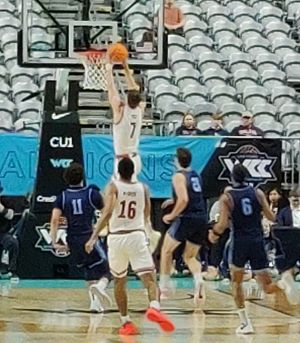
Los Angeles, CA — Despite entering the matchup as the favorite, Loyola Marymount never found its footing Saturday night, as Portland controlled the game from start to finish in a 71–58 road victory at Gersten Pavilion.
Coming into the contest, much of the intrigue centered around individual matchups. For LMU, former four-star USC recruit Jalen Shelley and Virginia Tech transfer Rodney Brown Jr. were players to monitor. On the Portland side, the focus was on Australian point guard Joel Foxwell, the conference leader in assists, and a player known more for craft than physicality.
Foxwell’s 6’1” frame appeared vulnerable during warmups, and LMU immediately tested him on the opening possession. Any concerns about his size, however, were quickly erased. From that point forward, Foxwell dictated the game with poise and precision, operating as the engine of Portland’s offense.
LMU attempted multiple defensive looks to disrupt him, picking him up full court, hedging hard on ball screens, and showing early help but none of it slowed him. Foxwell consistently split coverage, hit timely pull-ups and floaters, and delivered perfectly weighted passes to rolling big man James O’Donnell, his fellow Australian and ideal pick-and-roll partner. When help rotated, Foxwell punished it by finding open shooters. Portland’s offense flowed almost entirely through him, and it flowed effortlessly.
While Portland’s offense looked organized and confident, LMU’s attack never established rhythm. The Lions spent much of each possession swinging the ball several feet beyond the three-point line without creating advantages. Too often, possessions ended with late, low-confidence perimeter attempts or forced drives into a crowded paint.
Portland’s much-discussed defensive issues were not evident in the first half. Operating out of a 2-3 zone with high corners and guards sagging into the gaps, the Pilots clogged the interior and dared LMU to shoot. LMU obliged and missed although none of LMU’s shots looked like it was meant to be the result of their offense.
The disparity showed clearly on the scoreboard and in the box score. Portland led 39–21 at halftime, shooting 15-of-31 from the field and 4-of-8 from three, while LMU managed just 8-of-28 overall and 3-of-12 from deep. Portland also dominated the hustle categories, winning the rebounding battle 24–14 and forcing 10 LMU turnovers. Nearly every loose ball, long rebound, and transition opportunity favored the Pilots.
LMU briefly showed signs of life to open the second half, cutting the deficit to 10 with increased aggression on both ends. However, the underlying issues remained. The offense still lacked structure and spacing, and the shots that fell early were not sustainable.
Whenever LMU threatened to build momentum, Foxwell calmly extinguished it. He forced timely turnovers, hit key shots, and delivered highlight-level passes that led to layups or wide-open threes. Portland continued to look like a team with a clear identity, while LMU appeared disjointed and uncertain.
Jalen Shelley was the lone consistent bright spot for the Lions. He finished with 19 points and 10 rebounds on an efficient 7-of-12 shooting night, clearly establishing himself as LMU’s most impactful player. Yet even in his strong performance, Shelley was often underutilized. Instead of being featured as a primary option, he frequently stood in the corner or moved the ball quickly without being given the chance to dictate possessions. When Shelley attacked, LMU’s offense improved but those moments were too rare.
LMU’s second-half effort on the glass was commendable, as they won the rebounding battle 21–16 after intermission. The Lions also played with better energy defensively. Still, Portland’s structure and composure never wavered.
The Pilots closed the game with confidence, finishing 24-of-56 from the field and 8-of-17 from three. LMU ended the night shooting just 18-of-57 overall and 8-of-28 from deep, numbers that reflected an offense unsure of both its identity and its options.
Portland’s 71–58 victory was not simply a result of shooting variance or short stretches of momentum. It was the product of a disciplined game plan, executed by a team led by a point guard who controlled every phase of the contest. Foxwell played with the calm of a professional, and his leadership gave Portland a consistent advantage possession after possession.
LMU showed effort, particularly in the second half, but effort alone could not overcome Portland’s clarity of purpose. Until the Lions establish a defined offensive identity and commit to empowering their most effective players, performances like this will continue to follow.
This article was written by Miles Freed, a correspondent and scout for NetScouts Basketball. You can follow us on Instagram, or on twitter.
We are looking for those interested in our basketball scout apprenticeship program. For information contact us and forward your resume.