Tag:

miami hurricanes

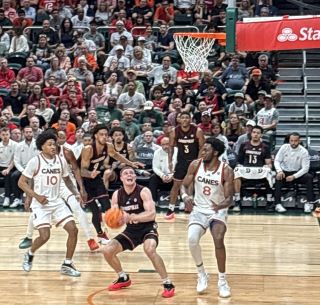
Miami, FL – In a game decided by the smallest of margins, Louisville narrowly defeated the University of Miami 92–89 in a highly competitive matchup that showcased efficient offense, balanced team play, and late-game drama. The contest remained tight throughout, with Louisville controlling much of the first half while Miami continually found ways to stay within striking distance.

From the opening tip, Louisville established a slight rhythm offensively, executing their sets with discipline and efficiency. They maintained a lead for most of the first half, but Miami consistently responded, preventing the game from ever slipping too far out of reach. Statistically, the two teams were remarkably even across multiple categories, reflecting how closely contested the matchup truly was.

Both teams finished with 22 assists, demonstrating strong ball movement and a willingness to create opportunities for teammates. Defensively, Miami recorded five steals while Louisville finished with four, another example of the minimal statistical separation between the two sides. Turnovers were also nearly identical: Louisville committed eight turnovers that resulted in 10 Miami points, while Miami had nine turnovers leading to 11 Louisville points.

Inside scoring was equally balanced as well. Each team scored 38 points in the paint, showing that neither side could consistently dominate interior play. Field goal production also mirrored the tight scoreline, with Miami making 32 field goals and Louisville finishing with 33.

Ultimately, the difference came down to execution in the final moments. With Louisville holding a narrow 90–89 lead late in the game, Miami had an opportunity to either take the lead or tie. However, a critical turnover occurred when Tre Donaldson received a sideline inbound pass and the timing of the play broke down, costing Miami a valuable possession. The game concluded with Tru Washington attempting a full-court heave to force overtime, but the shot fell short as time expired.

Despite the loss, Miami’s season under first-year head coach Jai Lucas has been impressive. The Hurricanes have demonstrated the ability to compete with anyone on their schedule, and covering the team throughout the season has shown that when Miami receives standout performances—particularly from Shelton Henderson—the team can challenge even the strongest opponents. At the same time, the experience and consistency of veteran players Malik Reneau and Tre Donaldson provide a foundation that helps stabilize the team in high-pressure situations.

Louisville’s offensive execution was highlighted by several strong individual performances. Senior guard Isaac McKneely, a 6-foot-4, 195-pound shooter, was particularly effective offensively. McKneely finished with 15 points on 6-of-11 shooting and displayed a smooth shooting form and strong shot selection throughout the game. Louisville consistently ran well-designed offensive sets that allowed him to find scoring opportunities within the flow of the offense.

Ryan Conwell, a 6-foot-4, 215-pound senior guard, delivered the most productive scoring performance of the night for Louisville. Conwell finished with 24 points on 7-of-14 shooting, including 4-of-9 from three-point range. His performance perfectly illustrated the difference between impact and production. In this game, Conwell provided both. He did not force shots, allowed the offense to develop naturally, and scored efficiently without disrupting the team’s rhythm. His defensive effort also contributed to Louisville’s overall performance.

For Miami, senior guard Donaldson, standing 6-foot-3 and 198 pounds, continues to elevate his game. Donaldson’s confidence as a scorer in clutch situations has grown noticeably as the season has progressed. His composure and decision-making suggest the potential to develop into an NBA-level point guard, and with Miami heading toward the NCAA Tournament, he will have an opportunity to showcase his abilities on a larger stage.

Shelton Henderson, a 6-foot-6, 240-pound forward, remains one of the most intriguing prospects on the roster and a potential top-20 NBA Draft selection. Henderson’s two-way potential is significant, combining physical strength with improved touch around the rim. As the season has progressed, his finishing ability and willingness to use his physicality have improved dramatically. Henderson consistently embraces his role, doing what is asked by his coaching staff and focusing on contributing to team success.

Senior center Ernest Udeh Jr., listed at 6-foot-11 and 266 pounds, also fulfilled his role effectively. Udeh provides interior presence, finishing alley-oop opportunities while anchoring the defense and rebounding effort. He is in excellent physical condition for a center—strong yet lean enough to move well laterally. While his offensive skill set is still developing, his defensive presence and rebounding ability could eventually allow him to carve out a role as a professional defensive specialist.

In the end, this matchup highlighted how thin the line between victory and defeat can be at the Division I level. With nearly identical statistical outputs and multiple strong individual performances, the game ultimately came down to late-game execution. Louisville capitalized on its opportunities just enough to secure the win, while Miami’s narrow loss underscored the competitive potential of a program that continues to grow under its new leadership.

This article was written by Matias Deya, a correspondent and scout for NetScouts Basketball.You can follow us on Instagram, or on twitter.

We are looking for those interested in our basketball scout apprenticeship program. For information contact us and forward your resume.

Miami, FLMiami edged out Virginia Tech 67-66 in a battle that was competitive from start to finish, defined by razor-thin margins, contrasting offensive styles, and one dominant individual performance that ultimately tilted the result. Despite trailing for much of the night and being out-executed in several statistical areas, Miami found a way to close, improving its record to 21–5 on the season.

The opening half set the tone early. After 13 minutes of play, the game had already featured multiple lead changes, with neither team able to establish control. Virginia Tech held a 25–24 advantage with seven minutes remaining in the first half, fueled by efficient shot-making. At that point, the Hokies were shooting 63% from the field (10–16), while Miami sat at 50% (10–20). Even so, Miami stayed attached by taking care of the basketball, committing just three turnovers compared to six by Virginia Tech.

By halftime, the game remained as even as it felt. Miami held a narrow edge on the glass (17–16), and both teams entered the break with six total turnovers. Execution-wise, Miami was functional but not fluid. The Hurricanes struggled to find a consistent offensive rhythm, relying more on individual shot-making than sustained ball movement. Still, their defensive discipline prevented Virginia Tech from capitalizing on its efficiency to create separation.

That trend continued in the second half. Virginia Tech led for roughly 57% of the game but never managed to pull away. The Hokies consistently generated quality looks through ball movement, finishing with 20 team assists compared to just seven for Miami. Despite that disparity, Miami remained composed defensively, stringing together enough stops to stay within one possession throughout most of the final stretch.

From a scouting standpoint, Virginia Tech freshman Neoklis Avdalas is the player from the Hokies who presents a fascinating evaluation. Avdalas finished with 2 points on 1–3 shooting, along with 5 rebounds and 8 assists. He stands out immediately as a tall guard with clear NBA tools. His defensive stance, wingspan usage, and comfort handling the ball align perfectly with the modern European guard prototype. The concern, however, remains offensive assertiveness. This game mirrored much of his season, minimal aggression in pursuing scoring opportunities and a tendency to defer, even when advantages were available. While his skill set suggests long-term NBA value, the inconsistency in production is notable. A return for his sophomore season could benefit both his physical development and confidence as a scorer. He still projects in the late first to early second round range, but his trajectory hinges on increased offensive responsibility.

For Miami, Shelton Henderson continued to validate his upward trend. Logging 37 minutes, Henderson posted 9 points, 6 rebounds, and 2 steals. While the scoring output was modest, his impact was felt through physicality, defensive engagement, and decisiveness. Earlier in the season, finishing through contact was a concern, as hesitation often disrupted his downhill attacks. That issue is fading fast. Henderson now plays with confidence, attacking gaps and continuing through traffic rather than pulling up or resetting. After his performance against UNC, this game further reinforced his status as a top-20 caliber prospect, even on a night where his scoring was not the focal point.

The decisive factor in Miami’s victory, however, was the performance of Tre Donaldson. In 36 minutes, Donaldson poured in 32 points on 13–24 shooting, including 3–7 from three, while adding 2 rebounds and 2 assists. The senior was simply unstoppable. Every time Virginia Tech made a push, Donaldson answered. He consistently beat defenders off the bounce, showing a deceptive first step and the ability to finish strong at the rim through contact. His poise stood out as much as his scoring, understanding when to attack, when to pull up, and when to shoulder the offense entirely. On a night when neither Henderson nor Malik Reneau had dominant scoring performances, Donaldson filled the role his team needed most, providing steady offensive pressure and late-game shot-making.

Ultimately, Miami’s 67–66 win was less about efficiency and more about resilience. Virginia Tech executed cleaner basketball for long stretches, but Miami’s defensive toughness and Donaldson’s scoring brilliance proved just enough to survive a game that easily could have swung the other way.

This article was written by Matias Deya, a correspondent and scout for NetScouts Basketball.. You can follow us on Instagram, or on twitter.

We are looking for those interested in our basketball scout apprenticeship program. For information contact us and forward your resume.

Miami, FLMiami delivered a poised and structured performance to defeat North Carolina 75–66 in a game they controlled from start to finish. Despite UNC’s perceived talent edge, the Hurricanes’ discipline, defensive versatility, and execution ultimately defined the outcome.

From the opening 10 minutes, Miami looked like the more organized team on both ends. UNC committed at least four careless turnovers early, while Miami valued possessions and dictated tempo. Shelton Henderson set the tone immediately, attacking the rim with aggression and finishing through contact. He played with visible edge and physicality, establishing himself as a consistent downhill presence.

Even with Miami executing more cleanly, UNC’s perimeter shooting kept the game competitive. Late in the first half, the Tar Heels were 6-of-11 from three compared to Miami’s 3-of-7, and the deficit remained minimal. At halftime, Miami led 43–40 — a three-point margin that felt reflective of execution versus raw talent. Miami played more cohesive basketball; UNC relied more heavily on individual playmaking.

A major separator was the turnover battle. Miami finished with just 8 turnovers, while UNC had 11, including 8 in the first half alone. That possession margin, paired with Miami’s 47% shooting from the field (compared to UNC’s 40%), prevented North Carolina from ever gaining control. In fact, UNC never held a lead in the game, often trailing by five or fewer points but failing to capitalize in key moments. Each time the opportunity arose, they settled for contested perimeter shots rather than attacking the zone with force.

Defensively, Miami impressed with its adaptability. The Hurricanes frequently operated out of a 2–3 zone that seamlessly shifted into a 1–3–1 alignment, at times placing a guard in the middle to disrupt passing lanes. UNC struggled to generate consistent interior pressure against it, and the lack of structured counters allowed Miami to stay organized and composed.

Caleb Wilson, the freshman 6’10” forward widely projected as a top-five pick, finished with 12 points on 4-of-10 shooting, along with 6 rebounds and 3 blocks. While not a dominant offensive outing by his standards, Wilson flashed the defensive timing and instincts that make him elite. His chase-down block ability and weakside rim protection were evident. However, there were moments where his lateral stance and perimeter containment could improve — particularly when Miami attackers beat him off the dribble, forcing help rotations that led to open finishes. His long-term projection remains extremely high, but this performance showed that refinement on-ball defensively will elevate his overall impact.

Jarin Stevenson was one of UNC’s more impressive performers on the night, finishing with 13 points on 6-of-10 shooting and 6 rebounds. At 6’10”, his size stands out immediately, but what was most intriguing was his ability to handle the ball effectively on aggressive drives. He displayed comfort attacking downhill and showed coordination that suggests untapped upside beyond his current statistical profile. Based on this performance alone, Stevenson warrants closer long-term evaluation.

UNC’s Luka Bogavac contributed 6 points on efficient perimeter shooting (2–3 from three) and continues to profile as a movement shooter. His mechanics are clean, and he relocates well off the ball to find space. However, his game remains heavily shooting-dependent. Limitations in ball handling, defensive versatility, and playmaking currently cap his overall impact, though his size at 6’6” gives him positional flexibility between the two and three.

Ultimately, four of Miami’s five starters scored 12 or more points, reinforcing how balanced and connected their attack was. This was not a win built on individual brilliance, but on cohesion, defensive structure, and possession discipline. For UNC, it was a frustrating loss, close throughout, yet never within their control.

Miami’s 75–66 victory was a clear example of team execution outweighing individual talent.

This article was written by Matias Deya, a correspondent and scout for NetScouts Basketball. You can follow us on Instagram, or on twitter.

We are looking for those interested in our basketball scout apprenticeship program. For information contact us and forward your resume.

Miami, FLMiami erased a double-digit halftime deficit and closed strong to defeat Pittsburgh 76–69, flipping the game with second-half defense, physicality, and star-level shot making. What began as a Pitt-controlled contest turned into a statement win for Miami, powered by Malik Reneau’s dominance and timely execution late.

The first half belonged to Pittsburgh. Defensively, Pitt set the tone early with length and activity across all five positions, making life difficult for Miami’s guards and wings. Passing lanes were crowded, drives were cut off early, and Miami struggled to generate clean looks. Through the final three minutes of the half, Miami shot just 9-of-27 from the field and an alarming 1-of-10 from three-point range, a reflection of both poor rhythm and Pitt’s disciplined closeouts.

Offensively, Pittsburgh complemented that defensive effort with efficient execution. They shot 14-of-27 from the field in the first half, consistently getting quality looks within their offense rather than forcing plays. Ball movement was sharp, and their ability to finish inside against Miami’s interior defense stood out. Miami’s problems were compounded when veteran forward Reneau went to the bench with foul trouble for the final five minutes of the half, limiting Miami’s best interior options. At halftime, Pittsburgh held a 43–33 lead and looked firmly in control, outplaying Miami in effort, execution, and overall physicality.

The game shifted quickly after the break. Miami opened the second half with a compact 3–2 defensive look that disrupted Pittsburgh’s rhythm almost immediately. Pitt struggled to find the same spacing and flow they enjoyed in the first half, missing several early possessions as Miami’s activity level spiked. The Hurricanes began winning second-chance opportunities and pushing the pace selectively, turning defense into offense without playing rushed.

Offensively, Miami simplified. Rather than overcomplicating sets, they leaned into physical drives, post touches, and straight-line actions that allowed their size to become an advantage. That approach brought them back into the game quickly and set the stage for  Reneau to take over.

Reneau delivered the most dominant individual performance of the game. He finished with 28 points on 8-of-13 shooting, went a perfect 10-of-10 from the free-throw line, and added eight rebounds. Pitt had no real answer for him in the paint. Reneau scored through contact, finished over length, and showed patience when double-teams came. His ability to get a quality look whenever Miami needed a basket completely changed the game’s momentum. Every Pitt run in the second half was answered by Reneau’s poise and touch around the rim.

Tre Donaldson was the other difference-maker late. He posted 19 points, four rebounds, and three assists, but his impact went beyond the box score. Donaldson controlled the tempo in crucial moments, balancing when to attack and when to involve teammates. His back-to-back three-pointers in the closing minutes effectively sealed the game, swinging the pressure firmly onto Pittsburgh. His command as a floor general stood out, particularly against a defense that had been strong for much of the night.

Despite the loss, Pittsburgh had notable individual performances. Cameron Corhen was highly effective, finishing with 17 points on 8-of-12 shooting and grabbing eight rebounds. At 6’10”, 235 pounds, Corhen showed good athleticism, fluid body coordination, and a relentless motor. He was aggressive on both ends and consistently made plays around the rim. While he may not yet project as a top-60 NBA prospect, his size, movement skills, and energy should continue to draw evaluators’ attention.

Brandin Cummings also flashed his natural scoring instincts, finishing with seven points, two rebounds, and two assists. Offensively, he has real shot-making ability, but his 6’3”, 175-pound frame limits his impact against physical lineups. Added strength and conditioning could significantly elevate his effectiveness at the college level.

In the end, the final score was  Miami 76- Pittsburgh 69. Pittsburgh dictated terms early with defense and execution, but Miami’s second-half adjustments, star power, and composure closed the door. It was a reminder that games often swing not on schemes alone, but on who can impose their will when it matters most.

This article was written by Matias Deya, a correspondent and scout for NetScouts Basketball. You can follow us on Instagram, or on twitter.

We are looking for those interested in our basketball scout apprenticeship program. For information contact us and forward your resume.

Miami Pulls Away from UL Monroe

by Carl Berman

Miami, FLMiami handled UL Monroe 104–79 in a game that was never really about execution or schemes, but about physical dominance and pace. From the opening half, it was clear Miami could get whatever it wanted inside, even though the outside shooting didn’t show up early. At halftime, Miami led 49–38 despite shooting just 18% from three, while UL Monroe was actually the more efficient perimeter team, hitting 47% from deep and 54% overall. The difference was simple: Miami overwhelmed them on the glass and at the rim, owning a 24–9 rebounding advantage and consistently punishing Monroe’s lack of interior resistance.

Miami played man-to-man from the opening tip, though the defensive effort wasn’t sharp. Rotations were slow, closeouts were late, and the overall energy felt muted at times—possibly a factor of the early start time. Even so, UL Monroe couldn’t capitalize enough to stay close because Miami’s physical advantages kept showing up possession after possession. Malik Reneau set the tone early, dominating inside with 16 points and 6 rebounds in the first half alone, scoring comfortably through contact and establishing deep position whenever he wanted. Miami’s ability to score without relying on the three kept them in control despite the shooting variance.

The second half followed a similar script, but Miami began to separate once the ball movement improved and open looks started to fall. About ten minutes in, the Canes had created real distance, pushing the lead through rim pressure and transition opportunities rather than shot-making difficulty. Miami did experiment with zone looks again against a lower-level opponent, but once more it proved ineffective. UL Monroe trimmed the lead to 76–62 with ten minutes left by attacking gaps and knocking down shots against the zone, reinforcing the idea that Miami’s identity is far more stable when they stick to man coverage. Once Miami reasserted control through pace and physicality, the game was effectively over.

Tre Donaldson had arguably his best all-around game as a true point guard, finishing with 18 points, 11 assists, and 6 rebounds on efficient shooting. What stood out most was his control of tempo. Donaldson played like a floor general, consistently putting teammates in scoring positions and letting the game come to him. When his mindset stays pass-first, Miami’s offense flows cleaner, and his scoring naturally follows without forcing the issue. His veteran presence showed, especially during moments when UL Monroe threatened small runs.

Ernest Udeh Jr. was another decisive factor. With 14 points and 15 rebounds, his size and strength completely overwhelmed Monroe’s frontcourt. Udeh plays like an old-school center, anchoring the paint, cleaning the glass, and imposing physicality on both ends. While his offensive fundamentals still need refinement, his rebounding presence and ability to control space around the rim were unmatched in this game. Miami won the interior battle comfortably, and Udeh was a major reason why.

Reneau continued to look like Miami’s most reliable interior scorer with this 22-point,10-rebound game on 10-15 FG attempts. His efficiency, comfort playing through contact, and ability to convert consistently around the rim stood out again. Miami leaned on him whenever they needed stability offensively, and UL Monroe simply didn’t have an answer for his strength and touch. When Miami needed a basket to stop momentum, the ball found Reneau.

On the other side, Renars Sondors showed intriguing traits for UL Monroe finishing with 14 points on 5-11 FG. He has good size and length, plays with controlled pace, and brought an aggressive offensive mindset in this matchup. His body control stood out, especially when attacking the basket, and his effort defensively was noticeable. The main area for growth is speed; both in decision-making and overall pace, but the tools are there for him to be a productive forward at NCAA Power 5 level.

Ultimately, this game was decided by physicality, rebounding, and interior scoring. Miami shot 60% from the field for the game and dominated the paint through Reneau and Udeh, while Donaldson orchestrated efficiently from the guard spot. Defensively, Miami still has room to improve, especially in terms of effort and consistency, but against UL Monroe, talent and strength were more than enough. The result was a fast-paced, high-scoring win that highlighted Miami’s strengths while still exposing areas that need tightening as competition improves.

This article was written by Matias Deya, a correspondent and scout for NetScouts Basketball. You can follow us on Instagram, or on twitter.

We are looking for those interested in our basketball scout apprenticeship program. For information contact us and forward your resume.

Miami, FLMiami gets the win against Southern Miss 88–64, but the game didn’t start that way at all. Southern Miss came out with an 8–0 run, matching Miami physically and dictating the pace early. Miami answered with Malik Reneau hitting back-to-back threes to calm everything down and make it 8–6 about five minutes in. Miami tried switching into 3-2 and 1-3-1 zone looks after scoring possessions, but both teams were struggling to create shots. The first ten minutes felt like a grind, effort on both sides, but no real rhythm offensively.

Southern Miss stayed man-to-man the entire first half and that defensive approach, plus their physical play, gave Miami problems. Miami’s zone coverage was not working at all, players staying planted with too many gaps, Southern Miss was attacking those holes easily in the first half. Man-to-man was just simply the better option for this noon game, but Miami didn’t fully lean on it until later.

At halftime the game was tied at 34–34. Miami shot 36% FG, Southern Miss was better at 50%. The rebounding edge went to Southern Miss. They brought physical energy on both ends. Miami wasn’t efficient because they weren’t getting clean looks, Southern Mississippi’s length and effort made them real uncomfortable.

Five minutes into the second half Miami built a 3-point lead, still shooting under 40%, but the talent difference was obvious. Southern Miss defended well and played tough but Miami still controlled the margin. The real shift occurred when Miami completely ditched the zone, exactly what needed to happen. Once they locked into man-to-man, everything flipped. Miami went on a 32–17 run across the next ten minutes and took full command, 66–51.

From there Miami opened a 20-point lead. They went back to zone a bit once the game was basically wrapped. Their starting five showed they are the group Miami can rely on. Southern Miss went to their reserves with five minutes left.

A huge part of Miami’s second-half surge was the performance from freshman Timotej Malovec. It was a breakout game for him. He finished with 16 points on 5-of-11 FG and 4-of-10 from three. His fundamentals are raw, but the tools are obviously there, good feel, smooth mechanics, great arc on the jumper. He only had one drive all game, but that euro-step finish told me everything I needed about his touch and pacing. Once he adds strength to his frame, his game is going to open up. I asked him about his role and he kept it simple: he does what the coaches ask. That discipline is going to take him far.

Reneau was Miami’s tone-setter. 21 points in 18 minutes on 6-of-12 FG and 2-of-3 from deep. Every shot looked comfortable. He’s Miami’s best producer on both sides. When he’s locked in, he has one of the strongest physical/skill combos in college basketball. The only critique from today’s game is pace. He plays slow at times, maybe part of Miami’s offensive structure, but if he pushes to impact every possession, he can rise quickly on draft boards.

Shelton Henderson quietly had one of the most complete performances: 12 points on 4-of-5 FG, plus 4 rebounds, 4 assists, 3 steals, 1 block. His defense was huge, especially in Miami’s zone packages where he had the freedom to use his physicality on the wing. I asked him about sometimes appearing passive offensively and loved his answer; he lets the game come to him and executes what coaches ask. With how much information young players have to process in today’s NCAA systems, that mindset makes sense. Some draft boards don’t even have him top-60, which is hard for me to understand. The size, the frame, the defensive reliability, he can match an NBA wing physically on defense today. He has first-round type tools.

Southern Miss’s Isaac Taveras, a skilled 6 ‘6 junior, had an off night. The coaching staff said it plainly: they couldn’t handle Miami physically, and execution broke down.

In the end, Miami’s second-half shift to man-to-man and the talent advantage from their core group blew the game open. The starting five showed they can stabilize and take over once they lock into what works. The first half exposed the weaknesses of the zone, but the second half was a complete response; physicality, discipline, shot-making, with young players stepping into real roles. Miami figured the game out and dominated the exact moment they needed to.

This article was written by Matias Deya, a correspondent and scout for NetScouts Basketball. You can follow us on Instagram, or on twitter.

We are looking for those interested in our basketball scout apprenticeship program. For information contact us and forward your resume.

Miami Takes Care of Elon

by Carl Berman

Miami, FL ~ The University of Miami handled business against Elon, 99–72, in a game that turned into an offensive showcase for both teams early before Miami’s pressure, discipline, and superior talent completely took over after halftime. Miami didn’t even have their starting center, but it didn’t really matter. They kept the full-court press on and off all night and switched everything in the half court, which immediately bothered Elon’s guards. Elon spent the entire game confused on the defensive end, opening in man-to-man for one possession, then suddenly switching to a 3–2 zone, then drifting back into man mid-possession like they forgot what they were running. That lack of structure gifted Miami open threes, driving lanes, skip passes and basically everything.

To Elon’s credit, they came out making tough shots. Chandler Cuthrell looked dominant early, scoring seven quick points and matching Miami physically better than expected. Both teams went small early, Reneau at the five for Miami, Cuthrell at the five for Elon, and it created a fast, up-tempo game. Miami shot 50% from the field in the first half, Elon shot 60%. It wasn’t great defense, it was just shot making and quick offense on both ends.

But the difference was the pressure. Miami forced nine turnovers before halftime and turned those into 13 points. They had seven steals by the break, compared to Elon’s one. That’s where the gap really started to form. Even with Elon hitting shots, Miami’s defense caused enough chaos to create separation. Miami led 47–41 at the half because they were simply the more active and physical group.

The second half is when the game blew open. Miami hit Elon with an 11–3 run in the first two minutes, and Elon immediately called timeout down 58–44. Nothing changed. Elon got completely lost defensively the entire second half. Their zone left massive gaps in the paint, and every rotation looked late or confused. Their offense was fine, they made shots all night, but you can’t win games giving up open three after open three and straight-line drives every other possession. Miami pulled away effortlessly and never looked back.

Shelton Henderson had the best offensive half of his young college career. He finished with 16 points on 7–11 shooting, but all of his damage was done in the first half. In his first minutes, he looked like the version of himself I’ve pointed out as a weakness. He missed two easy finishes at the rim and looked unsure of himself on drives. But once he settled in, he flipped the switch. He started finishing through contact, hit shots from the paint and from three, and physically he looked like a man among boys. What matters most for Henderson is mindset. He needs to stay aggressive, teams can’t handle his strength downhill. And he was easily Miami’s best perimeter defender tonight. He wasn’t getting scored on. His trajectory is clearly trending upward, and performances like this speed it up.

Malik Reneau continues being Miami’s most reliable interior scorer. He had 19 points, 6 rebounds and 4 assists, and did most of his work inside the paint. He’s athletic, in great shape, is physical, but he plays like an old-school big at 6’8”. That’s the concern long-term. Everything he does offensively is inside. He attempted three threes and missed all of them, and the bigger issue is his confidence. He passed up a wide-open three with two seconds left on the shot clock, then got blocked because he hesitated. That tells you exactly where his mindset is with perimeter shooting. If he ever becomes a confident and consistent outside shooter, he has an NBA shot. Right now, he’s a dominant college post player who needs one major skill unlock.

Tru Washington gave Miami 18 points on 7–of-9 shooting with 10 boards. He is aggressive, tough, and fearless. He’s listed at 6’4 but looks shorter, he relies on athleticism, quickness, and touch around the basket. He’s a very good athlete and a productive college guard, but the NBA margin is thin for guards his size. Unless he becomes an elite scorer, it’s hard to see him getting real NBA buzz. But he helps Miami win, and that matters.

Dante Allen, the Miami freshman, continues to stand out in flashes. He had 14 points with 5 rebounds, and hit 3-of-5 from deep. He’s built like a senior, is freaky athletic, and physically one of the more gifted guys on the floor. His jumper doesn’t look great mechanically, but he shoots it with confidence, and his defensive ceiling is legitimately high. He’s a hard player to project long-term right now because the role is inconsistent, but his impact is real every time he plays.

For Elon, Cuthrell had 15 points and showed early dominance before being completely removed from the game. And Bryson Cokley was easily their most impressive player, 14 points on 6–of-7 shooting, confident, skilled, and playing like someone who should not be coming off the bench. His defense needs work, but he flashed real talent.

Miami was simply the deeper, faster, stronger, more organized team, which is why this game ended in a blowout.

This article was written by Matias Deya, a correspondent and scout for NetScouts Basketball. You can follow us on Instagram, or on twitter.

We are looking for those interested in our basketball scout apprenticeship program. For information contact us and forward your resume.

Miami Rolls Past Stetson

by Carl Berman

Miami, FL – The University of Miami came out dominant once again, overpowering Stetson in a 102–61 win that displayed their size, strength, and composure on both ends of the floor. What began as a slow offensive start against Stetson’s compact 2–3 zone quickly turned into a one-sided contest, as Miami imposed its physicality and discipline throughout. The Hurricanes’ ability to stay patient, execute in the halfcourt, and make adjustments reflected the maturity of a team already finding rhythm early in the season.

Stetson opened the game organized defensively, sitting in a structured zone that initially gave Miami some issues. The Hurricanes missed several open shots early and looked stagnant from the perimeter, but their size advantage was immediately evident. They consistently crashed the glass and attacked the middle of the zone, forcing Stetson to collapse and open driving lanes. Once Miami started converting in the paint, everything else followed. Around the seven-minute mark of the first half, the Hurricanes went on a 15–0 run and never looked back, building a 55–36 halftime lead. Stetson battled, but the difference in athleticism and physical strength was clear, Miami simply operated at a higher level.

In the second half, the Hurricanes stuck to what worked. Their halfcourt offense continued to run through senior forward Malik Reneau, who set up on either side of the post and dictated tempo. His efficiency and composure anchored Miami’s attack as they kept breaking down Stetson’s defense. Once Miami started connecting on kick-out threes and transition looks, the game quickly got out of reach. Defensively, Miami’s man-to-man pressure suffocated Stetson’s rhythm, with active hands generating consecutive steals and transition opportunities. By the 16-minute mark of the second half, the Hurricanes had blown the lead open to 67–38, and the rest of the night was a formality.

Freshman Shelton Henderson continues to intrigue me as a prospect. At 6 ‘6”, 240 pounds, Henderson just looks like an NBA wing already from a physical standpoint, and he’s learning how to leverage that frame in live competition. Against Stetson, he posted 15 points, five rebounds and three assists, showing flashes of what could become a powerful skill-strength combination. He can be a downhill force, capable of bullying smaller defenders, but still struggles to finish through traffic and convert efficiently around the rim. The foundation is there, once he develops touch and consistency in the paint, he projects as a highly impactful two-way player.

Another freshman, Timotej Malovec, added 12 points on 4-of-6 shooting from three. His role remains limited in Miami’s system, primarily as a floor spacer, but he continues to make the most of his opportunities. His shot form looks more unconventional every time I see him, but the results speak for themselves, it goes in. While his game hasn’t expanded much beyond spot-up shooting yet, his size and feel give him long-term upside as a stretch forward who can complement Miami’s inside attack.

Senior forward Malik Reneau continues to be the Hurricanes’ interior anchor. He finished with 22 points, 10 rebounds, and three assists, showcasing his touch and strength around the basket. He’s a natural finisher with solid footwork and better athleticism than expected. The next step for Reneau is expanding his offensive range. He rarely looks for mid-range or three-point shots, which limits how versatile he can be in professional settings. Still, his efficiency and physicality in the paint remain consistent strengths.

Point guard Tre Donaldson orchestrated the offense with poise, finishing with 15 points, five rebounds, and ten assists.  The senior played with command, setting the tone early and creating opportunities for teammates. His confidence attacking the rim despite being undersized at 6’3” shows strong body control and competitiveness. Donaldson needs to look to become more of a true floor general, balancing scoring and facilitating effectively.

For Stetson, Sophomore James Phillips Jr. was the player to watch. As their best player this year, averaging 22 points per game, he finished this game with seven points shooting just 2-for-11 from the field. He’s a strong, 6’5” guard with sneaky athleticism and natural scoring instincts, though his defensive mobility remains limited. He has to get in better shape to maximize his big frame. His feel suggests potential as a shot creator if he can refine his efficiency and conditioning and possibly transfer to a power at some point.

Miami is now 3-0 and continues to pay well. This team has shown signs of a veteran, disciplined, and physical squad that has been dominant early in the season, though the schedule suggests it has been more than easy so far. Their defense was connected, their ball movement improved as the game progressed, and I would argue even though Miami won by 30 points they did not play a great game.

This article was written by Matias Deya, a correspondent and scout for NetScouts Basketball. You can follow us on Instagram, or on twitter.

We are looking for those interested in our basketball scout apprenticeship program. For information contact us and forward your resume.

Coral Gables, FL – The University of Miami rolled past Bethune-Cookman with a 101–61 victory, displaying a connected, disciplined group on both ends of the floor. Their defense stood out most with sharp rotations, consistent effort, and complete control of tempo. This performance came against a Bethune team that had just lost by only five points to No. 20 Auburn, making Miami’s dominance even more impressive.

From a scouting perspective, two freshmen in particular stood out as long-term prospects: Shelton Henderson and Timotej Malovec. Both have the physical and skill foundations that translate beyond the college level. Henderson (6’6, 240) finished with seven points, nine rebounds, and three assists in 22 minutes. He already carries an NBA-ready frame and strong defensive tools. The next step for him will be tightening his handle and becoming more confident offensively. With time and development, Henderson has the potential to become a first-round caliber player, possibly even a lottery pick if he continues refining his offensive package.

Malovec (6 ‘8, 214) was efficient in his minutes, shooting 3-of-5 from the field and 3-of-3 from three for nine points. His fundamentals are raw but clearly present. The jumper looks clean, his shot arc is smooth, and he plays within himself offensively. He’ll need to keep adding strength, but the foundation of a modern stretch forward is there. Henderson and Malovec are my two favorite pro prospects on this Miami roster, both carry real long-term potential if their development tracks upward.

Veteran forwards Malik Reneau (6’9, 238) and Tre Donaldson (6’3,198) led the way with experience and composure. Reneau was dominant around the rim, scoring 22 points with six rebounds and five assists on 9-of-12 shooting. His footwork and balance in the post were advanced, particularly finishing through contact with his left hand. Donaldson played with pace and control, adding 23 points and four assists on 9-of-11 from the floor. His handle and scoring feel were strong, though he’ll need to show more as a pure floor general to earn NBA looks.

Jakobi Heady (6’6, 200) also had a solid showing, posting 19 points on 6-of-13 shooting and 4-of-7 from three. His size and outside touch are valuable, but consistency and defensive intent will determine his next step.

Overall, Miami looked sharp, disciplined defensively, balanced offensively, and deep across positions. The upperclassmen brought stability, while the freshmen flashed legitimate NBA potential. Against a Bethune team that’s more competitive than the score suggests, this was a complete performance from a Miami group that seems built to keep climbing.

This article was written by Matias Deya, a correspondent and scout for NetScouts Basketball. You can follow us on Instagram, or on twitter.

We are looking for those interested in our basketball scout apprenticeship program. For information contact us and forward your resume.