Tag:

SEC Hoops

Nashville, TN – In a classic Southeastern Conference battle defined by toughness, defense, and timely shot-making, the Tennessee Volunteers escaped Nashville with a hard-fought 69–65 victory over the Vanderbilt Commodores.

The game featured multiple lead changes, momentum swings, and a dramatic finish that saw Tennessee’s Nate Ament deliver the decisive blow in the final seconds. Despite Vanderbilt’s strong second-half surge, the Volunteers’ composure and execution down the stretch proved to be the difference.

The first half set the tone for what would become a tightly contested affair. Both teams traded baskets early, with Tennessee’s defensive intensity matching Vanderbilt’s perimeter shooting. The Volunteers looked to establish their inside presence through Felix Okpara and Dewayne Browne II, while Vanderbilt relied on the steady playmaking of Duke Miles and the scoring touch of Tyler Tanner. Neither side could create much separation, and the half ended with Vandy holding a narrow lead, 35–31.

Coming out of the locker room, Vanderbilt seized control with an impressive run. Tanner sparked the surge with a pair of three-pointers, while Devin McGlockton and Jalen Washington controlled the glass, giving the Commodores multiple second-chance opportunities. Their energy and execution pushed the lead to nine points, forcing Tennessee head coach Rick Barnes to call a timeout to regroup. The Volunteers responded immediately, tightening their defense and finding rhythm offensively.

Ja’Kobi Gillespie, who had been steady all night, knocked down back-to-back threes to cut into the deficit. His confidence and poise helped Tennessee regain momentum, and soon the game was tied once again. From that point forward, the contest turned into a back-and-forth battle. Each possession carried weight, and both teams executed with urgency. Vanderbilt continued to rely on Tanner’s shot creation and Miles’ ability to penetrate and distribute, while Tennessee leaned on its balanced attack. Okpara and Browne II provided timely baskets inside, and Ament battled on the boards, keeping possessions alive and limiting Vanderbilt’s second-chance points. The intensity on both ends of the floor reflected the stakes of an SEC rivalry game, with neither team willing to concede an inch.

As the clock wound down, the tension inside Memorial Gymnasium reached its peak. With under a minute remaining and the score tied, Tennessee worked the ball around the perimeter, searching for a clean look. The ball found its way to Ament, who had struggled from the field for much of the night. Despite shooting just 3-for-11, the freshman forward showed no hesitation. With 54 seconds left, he rose up from mid-range and buried a tough, contested jumper to give Tennessee a 67–65 lead. Vanderbilt had one final chance to respond, but a missed shot on the ensuing possession allowed Tennessee to secure the rebound by Felix Okpara and close out the game at the free-throw line.

Ament’s final stat line—13 points, 9 rebounds, and the game-winning shot—did not fully capture his impact. Though his shooting numbers were below his usual efficiency, his resilience and confidence in the clutch defined Tennessee’s victory.

Gillespie led the Volunteers with 17 points, including three made three-pointers, providing the offensive spark that kept Tennessee within striking distance during Vanderbilt’s second-half run. Okpara and Browne II each contributed 8 points and 4 rebounds, offering steady interior play and defensive presence that anchored the Volunteers’ effort.

For Vanderbilt, Tanner continued his impressive season with 16 points, showcasing his ability to score at all three levels. Miles added 12 points and 6 assists, orchestrating the offense and keeping the Commodores competitive throughout. McGlockton chipped in 11 points and 5 rebounds, while Washington’s 8 points and 10 rebounds gave Vanderbilt a strong interior presence. Despite the loss, the Commodores displayed grit and balance, proving they can compete with one of the SEC’s top teams.

In the end, Tennessee’s ability to respond under pressure and execute in the final moments separated the two sides. The Volunteers improved their conference standing with a statement road win, while Vanderbilt was left to reflect on missed opportunities in a game that could have gone either way. As the SEC season continues, both teams will look to build on the lessons learned from this hard-fought contest—one that showcased the intensity, resilience, and drama that define college basketball in the South

This article was written by Andrew Keeling, a correspondent and scout for NetScouts Basketball. You can follow us on Instagram, or on twitter.

We are looking for those interested in our basketball scout apprenticeship program. For information contact us and forward your resume.

Atlanta, GA Mississippi State imposed its rhythm and physical play in an 85–73 road win over Georgia Tech on Wednesday night, relying on Josh Hubbard’s calm scoring bursts, Quincy Ballard’s inside presence, and timely outside shooting to control a game the Bulldogs led for the final 32 minutes. Georgia Tech’s early energy came primarily from Kowacie Reeves Jr., who scored a career-high 23 points on 8-of-20 shooting, including a strong 7-of-14 from three-point range. However, the rest of the Yellow Jackets shot just 18-of-57 from the field and 1-of-16 from deep, a disparity that defined the night.

Reeves opened the game with the smooth mechanics and balanced attacking he has shown all season, knocking down two early threes to help Georgia Tech take a 9–2 lead. His ability to shoot cleanly off movement, maintain consistent form, and make quick decisions off screens provided the Jackets with their most dependable source of offense. Mississippi State responded quickly. Hubbard’s composed ball handling, even as a streaky shooter, allowed the Bulldogs to settle into their preferred pace. He never rushed, skillfully navigating switches and pressure to guide Mississippi State through the early stretch.

The Bulldogs took their first lead at 15–13 during a run in which they scored 13 of the next 16 points, capitalizing on Georgia Tech’s cold spells and struggles finishing around the rim. Ballard’s long reach altered multiple shots, forcing the Jackets into difficult one-handed finishes — an area where Reeves, despite his scoring, can still be limited — and rushed floaters from his teammates. By the second media timeout, Mississippi State held a rebounding advantage and began controlling the paint, widening the margin as Georgia Tech’s efficiency sharply dropped.

Reeves continued to score through sharp cuts, relocations, and confident pull-up jumpers, but the Jackets struggled to find consistent help. Akai Fleming, who can pressure the rim with his strong frame, added 12 points but struggled as a perimeter shooter, allowing Mississippi State to sag and clog driving lanes. Baye Ndongo and Mouhamed Sylla each contributed 12, with Ndongo’s effort on the glass momentarily helping narrow the rebounding gap. Still, Tech never fully recovered from its long scoreless stretches.

Mississippi State entered halftime leading 37–28, buoyed by balanced contributions from Jayden Epps, Brandon Walker, and Jamarion Davis-Fleming. Their physical drives and timely cuts added needed scoring. Hubbard remained patient throughout, rarely forcing shots and maintaining control of the offense even when the Bulldogs weren’t shooting well from outside.

The Bulldogs opened the second half with a quick five points, increasing their lead to 16. Georgia Tech answered with its best stretch of the night — a 21–11 run sparked by Reeves’ continued perimeter accuracy and Ndongo’s hustle — trimming the deficit to 55–49 with 11 minutes remaining. For a moment, Tech’s energy, the crowd’s engagement, and Reeves’ shot-making created the sense that momentum might shift.

Hubbard quickly put that notion to rest. From the 55–49 mark, he scored nine straight points, showcasing the scoring ability that complements his steady floor leadership. He sank two threes and completed a three-point play to push the lead back to 66–51, and Georgia Tech never drew within single digits again.

Mississippi State maintained control of the paint, dominated the boards, and kept Georgia Tech’s non-Reeves shooters off balance. Hubbard finished with 25 points, while Epps, Walker, and Davis-Fleming each contributed in double figures. Ballard’s shot-blocking remained central, influencing Tech’s shot attempts far beyond the box score.

Georgia Tech, now 5–4, received 12 points each from Fleming, Ndongo, and Sylla, but their 1-of-16 shooting from deep outside of Reeves proved too great an obstacle to overcome. Despite Reeves’ strong performance and game-high nine rebounds, Tech’s offensive struggles and Mississippi State’s disciplined execution secured an 85–73 victory for the Bulldogs.

This article was written by Courtney Chappelle, a correspondent and scout for NetScouts Basketball. You can follow us on Instagram, or on twitter.

We are looking for those interested in our basketball scout apprenticeship program. For information contact us and forward your resume.

Las Vegas, NV. – The Oregon Ducks and Auburn Tigers opened the evening session of the  Players Era Festival at Mandalay Bay. Auburn pulled away late in the game to top Oregon 84-73. Tahaad Pettiford led the winners with 24 points on 9-of-18 shooting and added four assists and four rebounds. Takai Simpkins led the Ducks with 22 points, connecting on 5-of-8 3’s and making all seven of his free throws.

Auburn scored eight straight points late in the game, expanding a 60-59 lead to 68-59 and coasted to the win from there. Oregon couldn’t overcome off nights from their two top players, Jackson Shelstad and Nate Bittle. The two combined to shoot 6-of-28 from the field, including 2-of-15 from deep. Oregon was very loose with the ball (18 turnovers) and their spacing was poor on offense as in multiple sets there were four players on one end of the court. Simpkins made five poor passes and finished with seven turnovers. The team is still searching for a reliable secondary initiator on offense.

Bittle’s ineffectiveness inside helped Auburn gain a 38-24 advantage in points in the paint. The Tigers also held a 26-8 edge on layup points as the Ducks only had one blocked shot in the game. Pettiford has his way on offense, using his tight handle to continually create space from Oregon’s defenders and get off his shots. Neither team shot particularly well. Auburn was 5-of-23 on 3’s (21.7%) while Oregon connected on only 9-of-33 (27.3%). The difference was in Auburn’s effectiveness inside and on two-point shots where they converted 25-of-42 (59.5%) compared to Oregon’s 14-of-28. Because of their turnovers and general poor shooting the Ducks’ +12 edge in rebounding did not amount to much.

The teams battled to a 37-37 tie at the close of the first half. The Ducks had problems containing Auburn’s  Pettiford, The 6’1 Pettiford used his handle to get past Oregon’s defenders repeatedly. He finished the half as the leading scorer with 13 points on 6-of-12 shooting. Oregon’s 7’0 center, Nate Bittle led his team with 10 points and seven rebounds, banking in a three-pointer to even the game before the halftime break. Takai Simpkins added nine points on 3-of-4 from deep but was sloppy on his passing with five turnovers, The Ducks committed ten turnovers in the half compared to only three by Auburn with the Tigers having an 8-3 edge in points off turnovers.

Oregon will play San Diego State in the final game tomorrow night while Auburn goes on to face Michigan.

This article was written by Carl Berman, Managing Partner of NetScouts Basketball. You can follow us on Instagram, or on twitter.

We are looking for those interested in our basketball scout apprenticeship program. For information contact us and forward your resume.

Michigan State Overwhelms Kentucky at Champions Classic

New York, NY – In front of a packed crowd at Madison Square Garden Kentucky and Michigan State opened the Champions Classic. The first five minutes were the only time the game looked competitive — both teams put down threes and it was close for a while. Yet once Michigan State stabilized, the night changed decisively as they rolled to an 83-66 win.

The Spartans’ defensive pressure was on display from the get-go. Possession by possession, Michigan State tightened all corners, pressuring Kentucky into drive after drive, contested jumpers and off-balance attempts. The Wildcats soon lost their offensive rhythm. Meanwhile, Michigan State kept balance and poise and spacing across the floor — converting stops into clean looks and always grabbing the loose balls. As the Wildcats became more and more ineffective, the Spartans became more and more confident.

And the defining blow of the first half arrived in the final seconds. As the shot clock began to come to an end, Kur Teng came into rhythm and shot a deep jumper that put the Spartans ahead 44–27. It capped a career-best performance for Teng, who led with 15 points, ball-pointing with the assurance of a featured scorer instead of a role player. That shot, at that time, put the Spartans in control — control Kentucky just couldn’t wrestle back.

The Wildcats emerged from halftime more energetic, attempting to create momentum through transition and physical drives. But every push had stalled due to the same problems: bad shooting and the inability to get stops. With 9:37 left, Kentucky was shooting 35% from the field and 23% from three, and Michigan State was about 50% overall and more than 50% from deep. The gap reflected what played out on the floor.

Central to Michigan State’s calm, though, was point guard Jeremy Fears Jr., who played his most complete collegiate game. His pace, vision and method steered the Spartans all night. Fears ended with a career-high 13 assists, 8 points, 6 rebounds and 3 steals as he controlled Michigan State’s offense. Every move — pick-and-rolls, secondary reads, early offense — flowed from his ability to keep things steady and to set the tempo.

Inside, Jaxon Kohler penalized Kentucky’s interior. He scored 20 points on 8-of-12 shooting, through contact, sealing, and providing a consistent release valve when the Wildcats stepped in too big. Kohler’s mix of patience and strength established himself as a dependable anchor in the interior for which Kentucky never replied within their defense.

The Spartans also got some solid minutes from Cam Ward (8 points, 4 rebounds) whose athleticism, effort and energy paid off right away. Ward fought defensively, attacked the rim with confidence that jolted off the floor — one of the small but weighty traits that enabled Michigan State to keep its edge throughout the game.

Kentucky relied heavily on Otega Oweh, a 6’4″, 220-pound Newark native with a commanding frame and unblemished shooting technique. Oweh led the Wildcats with 12 points, attacking forcefully even as his perimeter touch shifted constantly and moved all over the place. Leaning behind him were Denzel Aberdeen, Collin Chandler, and New York product Mouhamed Dioubate — all three scored 10 points, but none could make the game turn around. Kentucky simply didn’t have enough of effective offense to keep up.

Still, the Wildcats were never able to exert actual pressure despite closing the gap to 10 late in the second half. Michigan State’s defensive rotations remained sharp, there was collective rebounding, and their execution never wavered. Each Kentucky push was met with a timely bucket, a clean read or a disciplined stop.

Michigan State’s shooting edge was substantial. Kentucky went 20-for-57 (35%) and 23% from three, while the Spartans closed at 50% from the field and 50% from deep in their 17-point victory with total control.  Michigan State looked very much like a team primed for success in this moment — efficient, disciplined, poised, and running with a clear line of vision. On the other hand, Kentucky showcased individual talent but not cohesion and defensive regularity. The contrast was clear leaving the Garden: Michigan State knows what it is. That’s still an answer Kentucky is looking for.

This article was written by Courtney Chappelle, a correspondent and scout for NetScouts Basketball. You can follow us on Instagram, or on twitter.

We are looking for those interested in our basketball scout apprenticeship program. For information contact us and forward your resume.
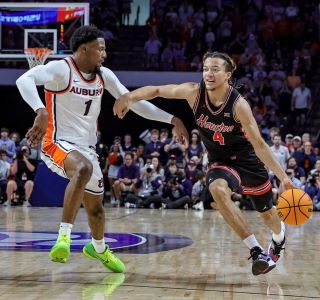
Birmingham, AL – The Houston vs. Auburn basketball matchup was a high-energy contest that lived up to expectations, showcasing elite athleticism, defensive intensity, and clutch shot-making from both sides. Houston’s trademark toughness and defensive discipline were on full display.  Auburn showed resilience and offensive firepower, keeping the game competitive throughout.  Auburn’s young core showed flashes of brilliance that bode well for their season ahead. Overall, Houston’s defensive execution and balanced scoring proved to be the difference in their 73-72 victory.

For the Cougars, Kingston Flemings set the tone early, controlling the tempo and attacking the rim with confidence. His ability to penetrate and finish through contact gave Houston a steady offensive rhythm when the game tightened. Fleming’s leadership and poise were crucial in key stretches. Flemings, a 6’4 freshman scored 22 points and added five rebounds and seven assists.

Chris Cenac Jr., a 6’11 freshman, was a force in the paint, using his length and athleticism to dominate the boards and protect the rim. He altered shots, ran the floor well, and provided second-chance opportunities that kept Houston in control. His energy on both ends made a noticeable impact. Cenac finished with 18 points and nine rebounds, shooting 2-of-3 from deep.

Emanuel Sharp delivered the scoring punch Houston needed from the perimeter. His shooting touch from deep stretched Auburn’s defense, and he hit timely shots that swung momentum back in Houston’s favor. Sharp’s confidence and ability to create his own shot were major factors in the Cougars’ offensive success. He was a bit off on his shooting tonight, ending the game with 13 points on 5-of-15 from the floor.

For the Auburn Tigers, Tahaad Pettiford was electric, using his quickness to break down defenders and create scoring chances. His ability to push the pace and finish in transition gave Auburn a spark whenever they needed a run. Pettiford finished with15 points on 5-of-14 shooting including 3-of-8 on threes.

Keyshawn Hall brought toughness and versatility, contributing on both ends of the court. He attacked the glass, defended multiple positions, and hit a few key mid-range jumpers that kept Auburn within striking distance. His hustle plays stood out even when the offense stalled. The 6’7, 240-pounder led the Tigers with 20 points and 11 rebounds.

Kevin Overton provided steady scoring from the wing, knocking down shots from beyond the arc and showing composure under pressure. His perimeter shooting helped space the floor and opened driving lanes for Pettiford and Hall. The 6’5 Overton had 13 points and five rebounds.

This article was written by Andrew Keeling, a correspondent and scout for NetScouts Basketball. You can follow us on Instagram, or on twitter.

We are looking for those interested in our basketball scout apprenticeship program. For information contact us and forward your resume.
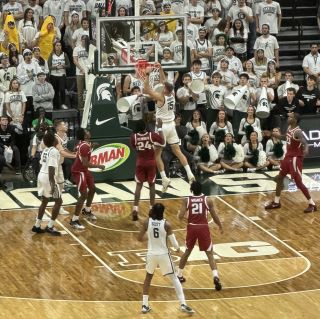
East Lansing, MI – The No. 22 Michigan State Spartans hosted the No.14 Arkansas Razorbacks Saturday night in a marquee top 25 showdown at the Breslin Center. The Spartans come in after earning their first home win of the 2025-26 season on Monday against Colgate, 80-69. Michigan State is coming off a 2024-25 season in which they went 30-7 overall and 17-3 in Big Ten conference play, losing in the Elite Eight to the top-ranked Auburn Tigers in last year’s NCAA Tournament. The Spartans lost four key players this year, two of whom are now in the NBA and NBA G League. They added 6’4 senior guard Trey Fort from Sanford to help at the two-guard position. They return a roster that contains a healthy balance of experience and youth, making for an intriguing 2025-26 team. 

There were stars on both sides as Michigan State’s 6’6 junior forward Coen Carr started the game scoring with a two-handed dunk off a drive in transition. Carr displayed his NBA-ready athleticism and vertical length all night, soaring for rebounds and challenging shots at the rim with his reach. Carr also showed his high level of motor and athleticism, flying in for a putback layup early in the game. Carr used his ball-handling and muscular frame to drive against defense pressure and finish strong around the rim. He impressed late in the contest, displaying his high motor, gathering an offensive rebound, and getting fouled on a dunk attempt. The junior was all over the floor all night for the Spartans.

6’2 Redshirt Sophomore Jeremy Fears Jr. did a stellar job handling the starting point guard duty for the Spartans as he used his quick burst to draw fouls on drives and convert at the free throw line. Fears Jr. controlled the ball against the Razorbacks’ full-court pressure and was a maestro, orchestrating for his teammates, leading the game with nine assists. He led the fastbreak well, finding Kohler for a transition layup in the second half to take a 45-42 lead. Defensively, he showed he is a strong pressure defender who forced a number of pickups above the three-point line, resulting in one steal on the evening.​

The Spartans’ 6’10 senior forward Jaxon Kohler also chipped in with a solid effort on both ends, contributing 10 points and seven rebounds. Kohler showcased his passing ability out of the low post, finding both Carr and Ward on basket cuts. He also used his big frame and footwork to carve out a low-post position, creating post-up opportunities. Kohler showed activity on the final possession of the first half as he tipped in a missed layup, trimming the Arkansas lead to 39-36 at halftime. Defensively, he moved his feet well, displaying activity in gap coverage, and showed he’s capable of contesting shots at the rim. The Spartans’ 6’11 senior center Carson Cooper is another large and physical big man who found himself in foul trouble in the first half. He played solid on both ends in the second, passing out of the high post and scoring in pick-and-roll situations. He demonstrated his athleticism, finishing two pick-and-roll lob passes from Fears Jr. with strong two-handed dunks. Both bigs move their feet well and cover enough space to play on the floor together on both ends of the floor.

​Michigan State’s best performance of the game came from 6’9 freshman forward Cam Ward, who came off the bench and had a huge impact, finishing with his first college career double-double of 18 points and 10 rebounds, going an efficient 8-of-13 from the field. Ward was the spark plug that Tom Izzo and the Spartans needed off the bench in this close battle. Ward is a strong rebound-and-run forward who covers space on the floor well with his natural size and length. Ward scored a number of times off middle cuts in the half-court and off baseline out of bounds, finishing strong with two-hand dunks. Ward played with a relentless motor, always looking to get involved in the play. He scored in the low post off a baseline drop step and dunk in the second half. Ward’s impact was felt on both ends of the floor all game.​

For Arkansas, they were led by future lottery pick 6’3 freshman guard Darius Acuff Jr. and 6’5 freshman forward Meleek Thomas, who each finished with 16 points. They both displayed their natural speed inside to get to the free-throw line and shooting mechanics in the catch-and-shoot, both knocking down a pair of three-pointers in the game. In the second half, Acuff Jr. got a quick rebound and pushed in transition, finishing with speed and strength on a layup. He is very athletic and explosive in the open court.

Along with Acuff Jr. and Thomas were 6’10 senior forward Trevon Brazile and 6’4 junior guard D.J. Wagner. Brazile and Wagner both displayed quick, strong shot releases, making them threats from the perimeter in the catch-and-shoot. Wagner impressed early, coming up with a steal and converting a strong one-handed dunk in transition. The Razorbacks also have 6’10 graduate forward Nick Pringle, who brings veteran leadership and sneaky athleticism. Defensively, Pringle rotated over on a middle drive and used his outstanding length and strength to reject a layup in the paint. 

In a close battle, both teams shot poorly from the perimeter, and most points were scored in transition. Michigan State dominated with points in the paint 45-28 as Cam Ward and both bigs shined in the instant classic. Late in the game, Acuff Jr. found Pringle around the basket for an athletic dunk as Arkansas made it a one-point game at 66-65 with less than three minutes left in the game. Pringle later found himself at the free-throw line as he made a free throw to tie the game at 66 with 1:41 left in the game. Both teams exchanged fouls and free-throw opportunities late. On the final Michigan State possession, Fears Jr. would absorb a hard foul with 43.2 seconds left and make two of the three free throws to put the Spartans up 69-66. Arkansas would miss multiple three-point opportunities as the Spartans held on for the 69-66 win.

This article was written by Nate Koesel, a correspondent and scout for NetScouts Basketball. You can follow us on Instagram, or on twitter.

We are looking for those interested in our basketball scout apprenticeship program. For information contact us and forward your resume.
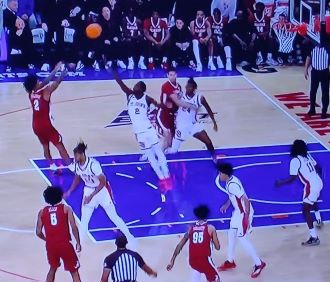
New York, NY – There’s nothing better than two of college basketball’s finest meeting for a showdown at the mecca and that’s exactly what we got between #5 ranked St. John’s and #15 ranked Alabama. In a high-scoring battle that stayed tight well into the second half, Alabama eventually pulled away for a 103–96 win, but the game was filled with standout performances on both sides.

St. John’s came out strong behind its frontcourt duo of Bryce Hopkins and Zuby Ejiofor, with Ejiofor mainly dominating the first half. He scored 21 points on 7-of-8 shooting before halftime, punishing Alabama inside and forcing the Crimson Tide into some early foul trouble, playing a key role in the Red Storm attempting 23 first-half free throws. Even more notable was Ejiofor knocking down jumpers, including two threes, something rarely seen last season when he made just 14 jumpers total. His shooting gave St. John’s another perimeter threat that they needed today. 

On the Alabama side, the backcourt of Labaron Philon and Aden Holloway carried the offense early, combining for 25 points in the first half. Holloway, returning from injury, looked poised and confident with 15 of those points on efficient shooting. Latrell Wrightsell, also making his season debut, gave them perimeter scoring and spacing. Alabama’s pace and three-point efficiency helped them take a 53–44 lead into halftime.

At halftime, St. John’s needed more from its guards, who were just 1-for-10 from the field. They responded. Ian Jackson and Oziyah Sellers came alive in the second half, both finishing with 14 points. They attacked downhill, used ball-handling creativity to open driving lanes, and put pressure on Alabama’s guards defensively. This sparked a run that brought the Red Storm back into striking distance and had the garden rocking at points in the second half. 

But Alabama did not fold. The second half turned into the Labaron Philon show, with Taylor Bol Bowen as his co-star two-way contributor. After a quieter first half, Philon controlled the game after the break. He manipulated pick-and-roll switches, created spacing off the dribble, finished at the rim, and generated playmaking advantages even when they didn’t show directly in his stats on the day. His poise and craftiness highlighted why he is projected as a potential lottery pick for the 2026 NBA Draft

Meanwhile, Bowen provided energy and toughness, finishing with 17 points and 9 rebounds while playing both the four and small-ball five roles. His rim protection, physicality, and defensive presence helped slow Ejiofor’s interior dominance from the first half. Bowen’s impact wasn’t just on the stat sheet he was a stabilizer during key possessions that prevented St. John’s from fully flipping the game in their favor.

Alabama’s mini-run late in the second half ultimately sealed the game, but the performance from both teams showed why each has high expectations this season.

For Alabama, the guard trio of Philon, Holloway, and Wrightsell was the main difference. Philon dictated tempo and also showed some NBA-level shot creation as well. Holloway complemented him as a secondary handler who could break down defenders with quickness and shot creation in ball screen situations. Wrightsell spaced the floor, stayed aggressive as a shooter, and made his presence felt defensively, in which he had four of Alabama’s nine steals. When these three guards are playing at this level, Alabama can beat anyone in the country.

For St. John’s, the main takeaway is that the core pieces showed high upside as a unit. Ejiofor looks to be carrying over his paint dominance with some willingness to expand his offensive range. Hopkins provided some steadiness and physicality. Jackson and Sellers showcased the ability to create off the bounce and attack the rim, something last year’s team lacked at times. The question moving forward is consistency, particularly perimeter shooting. The mechanics and confidence have shown improvement, but St. John’s will need reliable shot making from its guards to reach its maximum ceiling.

Still, there are clear positives. This year’s St. John’s backcourt is more dynamic, with players who can create their own offense instead of relying solely on sets or post up possessions. If that translates on a night-to-night basis, St. John’s will remain one of the toughest teams in the country again and a major threat to make a deep NCAA Tournament run, something last season’s historic team fell short of achieving.

Despite the loss, St. John’s showed resilience and improved offensive explosiveness, while Alabama reminded the country that they should not be slept on and displayed just how dangerous their roster can be. If this matchup is any indicator, both teams should be expected to stay near the top of the rankings as the season goes on.

This article was written by Jordan Amadeo, a correspondent and scout for NetScouts Basketball. You can follow us on Instagram, or on twitter.

We are looking for those interested in our basketball scout apprenticeship program. For information contact us and forward your resume.