Category:

News

Boulder, CO – In their last home game of the season before the Big 12 Conference Tournament next week Colorado hosted the Arizona Wildcats, who already had the first seed in Big 12 locked. Tad Boyle’s team was missing one of their main players, Sebastian Rancik, who has been on a concussion protocol. Rancik, a 6-11 forward, ranks second on the team in rebounding, steals and blocks and third in scoring and assists. His absence was easily felt against the No. 5 team in the country in points in the paint per game.

Arizona started the game slow, being eleven points down, which turned out to be the biggest lead for Colorado in the game. 6’8 Koa Peat, a projected first rounder in the upcoming NBA Draft, was  carried the Wildcats in the first half, dominating in the paint thanks to his advantageous athleticism and physicality which couldn’t be matched by Colorado’s frontcourt players. Peat had 19 points in the half, shooting 9-of-12 from the field to eventually finish the game with 25 points, three assists and four dimes. His shooting capabilities raise questions (a 60-percent shooter from the charity line) but a few mid-range shots in the game give some hope that with time and reps he could improve that aspect of his game. That might be crucial for how successful his NBA career would be.

Colorado’s backcourt duo of Isaiah Johnson and Barrington Hargress had a very efficient game which was the key to Colorado’s good performance in the first half. They took care of the ball, shot the ball very well (combined for 6-of-12 from the field), attacked the rim fearlessly, getting to the free throw line often (4-of-4 each). Hargress, a 6-foot-1, 190-pound junior guard showed his craftiness finishing in the paint using a good combination of understanding how to use his solid and tough upper body and a two-foot stop. Hargress is among the better playmakers in the NCAA, rarely turning the ball over, finishing the regular season with 4.4/1.2 assist to turnover ratio. On top of that he shoots the ball extremely well being close to 50% for the season.

Isaiah Johnson, the scoring leader for Colorado, had an impressive showing, finishing with 28 points and five assists, shooting 7-of-14 from the field. The 6-foot-1 speedy freshman displayed very good change of speeds and directions with tight handles as Arizona’s guards couldn’t stay in front of him. He was able to get to the charity stripe at ease (10-of-11 FT). Shooting wise, Johnson shows a pretty quick lefty release from outside, being able to hit threes off the dribble, on spot-ups and movement.


After a 36-36 first half in which Arizona couldn’t hit a three pointer (0-of-6), the Wildcats shot 4-of-5 in the second half and kept dominating in the paint. Arizona’s second-half comeback 89-79 win didn’t come easy though. It was led by Brayden Burries, a potential lottery draft pick in the upcoming NBA Draft. The 6-foot-4 freshman guard picked his game in the second half scoring 22 of his career-high 31 points. Burries, a talented and confident scoring guard with promising two-way potential has good positional size and an athletic body to go along with a good ability to get to the lane with crafty finishes around the rim. A confident 3-point shooter (2-of-5 in the game) Burries’ shooting form from outside looks pretty good with nice rotation and spin.

Arizona destroyed Colorado in the paint, outscoring them 54 to 26. The combination of Peat, Motiejus Krivas (10 points and 7 rebounds) and Tobe Awaka (10 points and 7 rebounds) was too much to handle for a Buffaloes’ frontcourt without Rancik.

Next week Colorado is are heading to Kansas City to face Oklahoma State on March 10 in the Big 12 Tournament, while Arizona  will start in the quarterfinals on March 12.

This article was written by Simeon Marinov, Director of European Scouting for NetScouts Basketball. You can follow us on Instagram, or on twitter.

We are looking for those interested in our basketball scout apprenticeship program. For information contact us and forward your resume.

New York, NY – After suffering their first loss since January 3rd, St. John’s came into Madison Square Garden looking for a bounce back win vs. Kevin Willard’s Villanova Wildcats. Villanova has been one of the bigger surprises in college basketball this season being in the upper tier of the Big East so we thought we were in for a close game. However, St. John’s dominated on both ends of the floor in the first half with everyone that touched the floor providing a positive impact. Leading the way was the play of Ian Jackson and Zuby Ejiofor, Jackson in particular was extremely active in his minutes. The biggest story of the half was St. John’s defense as they forced 8 turnovers and were able to capitalize scoring 18 points off of those Wildcats mistakes. This was the key to St. John’s taking a 48-23 lead heading into the break 

Unfortunately for Villanova they would continue to get outclassed in the second half by the Johnnies. St. John’s would go on to force 8 more turnovers in the half and cause havoc in transition. The duo of Jackson and Ejiofor picked up from where they left off in the first half as Jackson would finish with 19 points while also grabbing 5 steals and Zuby would have his first career triple double as well. Villanova didn’t really get any standout performances as it was a rough night for leading scorer Tyler Perkins who finished with 3 points on 1-of-5 shooting. It was a night of domination for St. John’s last night as they took all their frustration from their loss to UConn and took it out on the Wildcats winning by a final score of 89-57. This win over Villanova was their largest win of all time vs. the Wildcats as they continue on the quest to win the Big East regular season championship for the second season in a row. 

St. John’s is hard to beat when they get positive contributions from Jackson and it was proven once again last night against a tough Villanova team. Jackson showed his potential as a microwave scorer with his ability to play on and off the ball. When the shot falls it opens up the best part of his game which is his ability to get to the rim. Although what impressed me the most about his performance last night was his defensive impact. The motor guarding on the ball and his activity in the passing lanes was incredible as he completely changed the momentum of this game. 

Once again the favorite for this season’s Big East player of the year, Zuby Ejiofor, continued to prove why he’s one of the best players in college basketball. The impact he provides on both sides of the floor is second to none on this St. John’s team and it was fully on display last night recording a triple double with 4 stocks on the side. His performance was truly a characterization of the fact that he can do a little bit of everything on the basketball court.  Ejiofor is one of the most valuable players in the country this season and has a legitimate chance to be drafted in the 1st round of the upcoming NBA Draft this June.

This article was written by Jordan Amadeo, a correspondent and scout for NetScouts Basketball. You can follow us on Instagram, or on twitter.

We are looking for those interested in our basketball scout apprenticeship program. For information contact us and forward your resume.
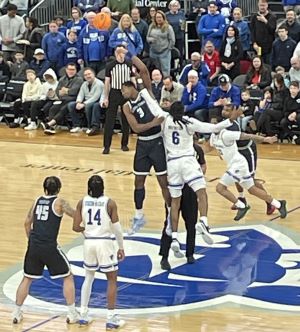
Nashville, TN – In a classic Southeastern Conference battle defined by toughness, defense, and timely shot-making, the Tennessee Volunteers escaped Nashville with a hard-fought 69–65 victory over the Vanderbilt Commodores.

The game featured multiple lead changes, momentum swings, and a dramatic finish that saw Tennessee’s Nate Ament deliver the decisive blow in the final seconds. Despite Vanderbilt’s strong second-half surge, the Volunteers’ composure and execution down the stretch proved to be the difference.

The first half set the tone for what would become a tightly contested affair. Both teams traded baskets early, with Tennessee’s defensive intensity matching Vanderbilt’s perimeter shooting. The Volunteers looked to establish their inside presence through Felix Okpara and Dewayne Browne II, while Vanderbilt relied on the steady playmaking of Duke Miles and the scoring touch of Tyler Tanner. Neither side could create much separation, and the half ended with Vandy holding a narrow lead, 35–31.

Coming out of the locker room, Vanderbilt seized control with an impressive run. Tanner sparked the surge with a pair of three-pointers, while Devin McGlockton and Jalen Washington controlled the glass, giving the Commodores multiple second-chance opportunities. Their energy and execution pushed the lead to nine points, forcing Tennessee head coach Rick Barnes to call a timeout to regroup. The Volunteers responded immediately, tightening their defense and finding rhythm offensively.

Ja’Kobi Gillespie, who had been steady all night, knocked down back-to-back threes to cut into the deficit. His confidence and poise helped Tennessee regain momentum, and soon the game was tied once again. From that point forward, the contest turned into a back-and-forth battle. Each possession carried weight, and both teams executed with urgency. Vanderbilt continued to rely on Tanner’s shot creation and Miles’ ability to penetrate and distribute, while Tennessee leaned on its balanced attack. Okpara and Browne II provided timely baskets inside, and Ament battled on the boards, keeping possessions alive and limiting Vanderbilt’s second-chance points. The intensity on both ends of the floor reflected the stakes of an SEC rivalry game, with neither team willing to concede an inch.

As the clock wound down, the tension inside Memorial Gymnasium reached its peak. With under a minute remaining and the score tied, Tennessee worked the ball around the perimeter, searching for a clean look. The ball found its way to Ament, who had struggled from the field for much of the night. Despite shooting just 3-for-11, the freshman forward showed no hesitation. With 54 seconds left, he rose up from mid-range and buried a tough, contested jumper to give Tennessee a 67–65 lead. Vanderbilt had one final chance to respond, but a missed shot on the ensuing possession allowed Tennessee to secure the rebound by Felix Okpara and close out the game at the free-throw line.

Ament’s final stat line—13 points, 9 rebounds, and the game-winning shot—did not fully capture his impact. Though his shooting numbers were below his usual efficiency, his resilience and confidence in the clutch defined Tennessee’s victory.

Gillespie led the Volunteers with 17 points, including three made three-pointers, providing the offensive spark that kept Tennessee within striking distance during Vanderbilt’s second-half run. Okpara and Browne II each contributed 8 points and 4 rebounds, offering steady interior play and defensive presence that anchored the Volunteers’ effort.

For Vanderbilt, Tanner continued his impressive season with 16 points, showcasing his ability to score at all three levels. Miles added 12 points and 6 assists, orchestrating the offense and keeping the Commodores competitive throughout. McGlockton chipped in 11 points and 5 rebounds, while Washington’s 8 points and 10 rebounds gave Vanderbilt a strong interior presence. Despite the loss, the Commodores displayed grit and balance, proving they can compete with one of the SEC’s top teams.

In the end, Tennessee’s ability to respond under pressure and execute in the final moments separated the two sides. The Volunteers improved their conference standing with a statement road win, while Vanderbilt was left to reflect on missed opportunities in a game that could have gone either way. As the SEC season continues, both teams will look to build on the lessons learned from this hard-fought contest—one that showcased the intensity, resilience, and drama that define college basketball in the South

This article was written by Andrew Keeling, a correspondent and scout for NetScouts Basketball. You can follow us on Instagram, or on twitter.

We are looking for those interested in our basketball scout apprenticeship program. For information contact us and forward your resume.

Newark, NJ — After a gut-wrenching loss to DePaul earlier in the week, Seton Hall responded in a big way Saturday against Georgetown, grinding out a much-needed 51–47 victory. In a physical, defense-first battle where both teams shot under 32% from the field, clean looks were hard to come by and every possession carried weight. The Pirates leaned into the toughness of the game, tightening up defensively and doing just enough offensively down the stretch to secure a gritty win that keeps them moving forward.

The difference-maker in this game was freshman big man Najai Hines, who recorded 12 points and 10 rebounds to secure his third collegiate double-double. Hines was a force in the paint, consistently playing above the rim and finishing through contact, converting multiple and-one opportunities. Beyond his scoring, he made a major impact on the glass, pulling down five offensive rebounds that generated crucial second-chance points in a game where every basket mattered.

Hines was just as influential defensively, finishing with five blocks and two steals. He did an excellent job reading Hoya attackers, timing their shot attempts, and swatting them with authority. His most important contribution, however, won’t appear in the box score. On Georgetown’s final possession, Vince Iwuchukwu caught the inbound and tried to drive past Hines, but Hines stayed disciplined and kept him in front. That containment allowed Elijah Fisher to dig down, disrupt the play, and create a loose ball that ultimately sealed the Pirates’ victory.

The biggest factor in tonight’s win was Seton Hall’s team defense. The Pirates limited clean looks all night, and even when Georgetown found open shots, they struggled to capitalize. Seton Hall had active hands and high energy from start to finish, contesting nearly every attempt and making life uncomfortable for opposing shooters.

They finished with nine total blocks, including a few impressive swats out near the three-point line, showcasing their versatility and effort on closeouts. Their activity extended into the passing lanes as well, consistently disrupting offensive flow. Budd Clark led the way with three steals, while AJ Staton-McCray and Hines each chipped in two, highlighting a collective defensive effort that ultimately set the tone for the game.

With the win, Seton Hall regains some momentum as it prepares for a major test next Saturday on the road against the UConn Huskies. A trip to Storrs presents a significant challenge, but if the Pirates can replicate the defensive intensity and physicality they displayed against Georgetown, they will give themselves a chance to compete. Meanwhile, the Georgetown Hoyas return home looking to bounce back when they host the Marquette Golden Eagles on Tuesday. As conference play tightens, every game grows in importance, and both programs will be eager to build on—or respond to—the lessons learned in this defensive battle.

This article was written by William Murphy, a correspondent and scout for NetScouts Basketball. You can follow us on Instagram, or on twitter.

We are looking for those interested in our basketball scout apprenticeship program. For information contact us and forward your resume.

Newark, NJ — With Seton Hall’s season hanging in the balance, the Pirates understood the importance of protecting their home floor to keep their tournament hopes alive. However, Tuesday night’s loss to DePaul in Newark delivered a significant blow to their at-large aspirations. The Blue Demons controlled the game from start to finish, outplaying the Pirates in nearly every facet. DePaul combined tenacious defense with a well-structured offensive approach, matching Seton Hall’s physicality and refusing to be pushed around. Down the stretch, the Blue Demons forced multiple key turnovers, sealing momentum and ultimately securing a 69–57 victory.

Two major factors in DePaul’s win were NJ Benson and CJ Gunn, who combined for 39 points and consistently applied pressure on the Pirates. Benson led the way with 21 points and eight rebounds, imposing his will in the paint. He played through contact, backing down Seton Hall’s big men and either drawing fouls by getting them off their feet or converting tough, contested finishes around the rim. Benson also attacked the offensive glass with purpose, generating multiple second-chance opportunities that kept DePaul in control.

Gunn added 18 points and seven rebounds, showcasing impressive shot creation and confident shot-making. The smooth shooter was relentless off the ball, sprinting off screens and using constant movement to create separation. His activity eventually led to clean looks, and he capitalized, delivering timely buckets that helped maintain the Blue Demons’ momentum throughout the game.

Once again, Budd Clark paced the Pirates, finishing with 19 points and five assists. He consistently found his way to his patented midrange jumper, knocking down difficult shots off ball screens—especially when DePaul’s bigs switched onto him. In the first half, Clark was particularly effective as a playmaker, controlling the tempo and creating opportunities for his teammates. However, that same level of facilitation didn’t carry over into the second half, which proved costly as the Pirates searched for rhythm offensively.

Turnovers also became a key issue. Clark finished with five giveaways, including several ball-security lapses in the final four minutes that stripped Seton Hall of valuable possessions. Those mistakes halted momentum and made an already challenging comeback attempt feel even more out of reach.

Another element that cannot go unnoticed was the impressive X’s and O’s execution from the DePaul coaching staff. Time and time again, the Blue Demons came out of timeouts with well-designed ATO sets that had the Pirates scrambling defensively, often resulting in clean, uncontested scoring opportunities. Chris Holtmann and his staff have taken on the difficult challenge of revitalizing a historically struggling program, and the early signs are promising. With Holtmann at the helm, DePaul appears far more structured and disciplined, and they project to be a difficult opponent as long as he is leading the program.

Looking ahead, the urgency only increases for the Seton Hall Pirates, who return home Saturday for a pivotal matchup against Georgetown. With their tournament hopes still within reach, protecting home court is no longer optional — it’s essential. A strong response will be needed to regain momentum and restore confidence after Wednesday’s setback. Meanwhile, DePaul will aim to build on their statement win when they host the Providence Friars. If the Blue Demons replicate the same defensive intensity and disciplined execution they displayed in Newark, they’ll have a strong opportunity to continue their upward trajectory and further solidify themselves as a team capable of making noise down the stretch.

This article was written by William Murphy, a correspondent and scout for NetScouts Basketball. You can follow us on Instagram, or on twitter.

We are looking for those interested in our basketball scout apprenticeship program. For information contact us and forward your resume.

Miami, FLMiami edged out Virginia Tech 67-66 in a battle that was competitive from start to finish, defined by razor-thin margins, contrasting offensive styles, and one dominant individual performance that ultimately tilted the result. Despite trailing for much of the night and being out-executed in several statistical areas, Miami found a way to close, improving its record to 21–5 on the season.

The opening half set the tone early. After 13 minutes of play, the game had already featured multiple lead changes, with neither team able to establish control. Virginia Tech held a 25–24 advantage with seven minutes remaining in the first half, fueled by efficient shot-making. At that point, the Hokies were shooting 63% from the field (10–16), while Miami sat at 50% (10–20). Even so, Miami stayed attached by taking care of the basketball, committing just three turnovers compared to six by Virginia Tech.

By halftime, the game remained as even as it felt. Miami held a narrow edge on the glass (17–16), and both teams entered the break with six total turnovers. Execution-wise, Miami was functional but not fluid. The Hurricanes struggled to find a consistent offensive rhythm, relying more on individual shot-making than sustained ball movement. Still, their defensive discipline prevented Virginia Tech from capitalizing on its efficiency to create separation.

That trend continued in the second half. Virginia Tech led for roughly 57% of the game but never managed to pull away. The Hokies consistently generated quality looks through ball movement, finishing with 20 team assists compared to just seven for Miami. Despite that disparity, Miami remained composed defensively, stringing together enough stops to stay within one possession throughout most of the final stretch.

From a scouting standpoint, Virginia Tech freshman Neoklis Avdalas is the player from the Hokies who presents a fascinating evaluation. Avdalas finished with 2 points on 1–3 shooting, along with 5 rebounds and 8 assists. He stands out immediately as a tall guard with clear NBA tools. His defensive stance, wingspan usage, and comfort handling the ball align perfectly with the modern European guard prototype. The concern, however, remains offensive assertiveness. This game mirrored much of his season, minimal aggression in pursuing scoring opportunities and a tendency to defer, even when advantages were available. While his skill set suggests long-term NBA value, the inconsistency in production is notable. A return for his sophomore season could benefit both his physical development and confidence as a scorer. He still projects in the late first to early second round range, but his trajectory hinges on increased offensive responsibility.

For Miami, Shelton Henderson continued to validate his upward trend. Logging 37 minutes, Henderson posted 9 points, 6 rebounds, and 2 steals. While the scoring output was modest, his impact was felt through physicality, defensive engagement, and decisiveness. Earlier in the season, finishing through contact was a concern, as hesitation often disrupted his downhill attacks. That issue is fading fast. Henderson now plays with confidence, attacking gaps and continuing through traffic rather than pulling up or resetting. After his performance against UNC, this game further reinforced his status as a top-20 caliber prospect, even on a night where his scoring was not the focal point.

The decisive factor in Miami’s victory, however, was the performance of Tre Donaldson. In 36 minutes, Donaldson poured in 32 points on 13–24 shooting, including 3–7 from three, while adding 2 rebounds and 2 assists. The senior was simply unstoppable. Every time Virginia Tech made a push, Donaldson answered. He consistently beat defenders off the bounce, showing a deceptive first step and the ability to finish strong at the rim through contact. His poise stood out as much as his scoring, understanding when to attack, when to pull up, and when to shoulder the offense entirely. On a night when neither Henderson nor Malik Reneau had dominant scoring performances, Donaldson filled the role his team needed most, providing steady offensive pressure and late-game shot-making.

Ultimately, Miami’s 67–66 win was less about efficiency and more about resilience. Virginia Tech executed cleaner basketball for long stretches, but Miami’s defensive toughness and Donaldson’s scoring brilliance proved just enough to survive a game that easily could have swung the other way.

This article was written by Matias Deya, a correspondent and scout for NetScouts Basketball.. You can follow us on Instagram, or on twitter.

We are looking for those interested in our basketball scout apprenticeship program. For information contact us and forward your resume.

Eugene, OR — The Oregon Ducks faced the Minnesota Golden Gophers with both teams vying for momentum as the Big Ten Tournament ramps up in March. Minnesota dominated the second half by outscoring Oregon 32 to 14 in the final 13 minutes of actions to roll to 61-44 road win at Matthew Knight Arena in front of 5,204 fans.

Isaac Asuma set the tone early, scoring Minnesota’s first five points on his way to a game-high 15 points on 6-of-14 shooting. The point guard added five rebounds and four assists, though he also committed four turnovers. Minnesota’s defense proved just as impactful, holding Oregon to 30 percent shooting in the first half and just 1-of-12 from three-point range. For the game, the Ducks finished a very poor 2-of-20 from beyond the arc.

Midway through the first half, Minnesota endured a nearly seven-minute stretch without a field goal. Senior Cade Tyson, who entered the night averaging 19.5 points per game, broke the drought late in the half. His five first-half points sparked a 12–2 run that pushed the Gophers ahead 22–13 before they carried a 22–17 lead into halftime. Tyson finished with 12 points on 3-of-10 shooting, along with eight rebounds and three assists.

After a sluggish offensive first half, Oregon turned to senior center Nate Bittle to generate momentum. Using high-low action to attack Minnesota’s zone defense, the 7-footer converted several interior looks to keep the Ducks within striking distance. Bittle totaled 15 points (7-for-15 FG), adding eight rebounds, four assists, and two blocks.

Oregon briefly reclaimed the lead at 30–29 when Kwame Evans Jr. knocked down a three-pointer from the wing, marking the Ducks’ first lead since 2–0. Evans finished with 13 points on 5-of-9 shooting, along with eight rebounds and four assists. Dezdrick Lindsay chipped in eight points off the bench, but consistent scoring options were limited.

Minnesota quickly responded behind key contributions from Grayson Grove and Bobby Durkin. Grove, who entered averaging just three points per game, scored 13 points (5-for-9 FG) and grabbed eight rebounds. Durkin added 11 points, connecting on three shots from beyond the arc. The pair combined for 21 of Minnesota’s 39 second-half points. 

The Gophers also controlled the glass, outrebounding the Ducks 38–28 and holding a 13–7 advantage on the offensive boards to seal the road win.

Oregon (9-17, 2-13) travels south to challenge USC (18–7, 7-7) on Saturday. Minnesota (12–14, 5-10) will return home to face Rutgers (10-15, 3-11) .

This article was written by Chad Mart, a correspondent and scout for NetScouts Basketball. You can follow us on Instagram, or on twitter.

We are looking for those interested in our basketball scout apprenticeship program. For information contact us and forward your resume.

Atlanta, GA – In a highly anticipated matchup between two nationally ranked Division 3 programs, the Emory University Eagles delivered a statement victory over the New York University Violets, pulling away in the second half for a commanding 103–80 win. The contest, which featured two teams sitting comfortably within the top 25, showcased high-level basketball, elite guard play, and a second-half surge that solidified Emory’s position as one of the premier teams in the country. With the win, Emory improved to 19–3 on the season, while NYU dropped to 16–6.

The first half lived up to the billing of a top-tier matchup. Both teams traded baskets early, with neither side able to establish a significant lead. Emory’s fast-paced offense, led by the dynamic backcourt of Ben Pearce and Jair Knight, was met by NYU’s disciplined half-court execution and strong interior presence. The pace was frenetic, with both teams pushing the tempo and converting in transition. Emory’s ball movement and spacing created open looks from the perimeter, while NYU countered with efficient scoring from their leading scorer, Luke Kolaja, who was nearly unstoppable in the opening 20 minutes.

Kolaja’s ability to score from all three levels kept NYU within striking distance. He poured in 18 first-half points, attacking off the dribble and finishing through contact. Emory, however, found consistent offense through Pearce, who orchestrated the attack with precision. His combination of scoring and playmaking allowed the Eagles to maintain a slim advantage heading into halftime. By the break, Emory held a narrow 52–48 lead, setting the stage for what appeared to be a tightly contested second half.

That expectation quickly changed once the teams returned from the locker room.

Emory came out with renewed energy and defensive intensity, immediately setting the tone for the remainder of the game. The Eagles ramped up their pressure on the perimeter, forcing NYU into rushed possessions and turnovers that fueled Emory’s transition game. Pearce continued his stellar play, finding teammates in rhythm while also attacking the rim with confidence. His leadership and poise were evident as Emory began to separate on the scoreboard.

The turning point came midway through the second half when Emory went on a decisive 18–4 run, sparked by back-to-back three-pointers from Knight and a series of fast-break finishes by Pearce and AJ Harris. The Eagles’ ball movement was crisp, their spacing impeccable, and their defensive rotations sharp. NYU struggled to find consistent offense outside of Kolaja, who continued to battle but received limited support as Emory’s defense tightened.

By the 10-minute mark, Emory had extended its lead to double digits, and from there, the outcome was never in doubt. The Eagles’ depth and conditioning became apparent as they continued to push the pace and execute efficiently on both ends. Knight’s athleticism and scoring versatility were on full display, as he attacked the basket, hit mid-range jumpers, and contributed on the glass. He finished with 23 points and 6 rebounds, providing a strong complement to Pearce’s dominant performance.

Pearce was the clear catalyst for Emory’s offensive explosion. The senior guard delivered one of his best performances of the season, tallying 31 points, 9 assists, and 4 rebounds. His ability to control the tempo, create for others, and score in a variety of ways made him nearly impossible to contain. Whether pulling up from deep, slicing through defenders, or finding open teammates, Pearce dictated the flow of the game from start to finish.

Supporting contributions came from Harris and Ethan Faust, both of whom played key roles in maintaining Emory’s momentum. Harris added 15 points, providing timely scoring and defensive energy, while Faust chipped in 11 points and 7 rebounds, anchoring the interior and helping limit NYU’s second-chance opportunities. The balanced scoring attack and unselfish play were emblematic of Emory’s team identity—a disciplined, high-octane offense paired with relentless defensive effort.

For NYU, Kolaja’s 32-point performance was a bright spot in an otherwise difficult night. His scoring kept the Violets competitive early, but as Emory’s defense adjusted, his opportunities became more contested. Quinn Clark also turned in a solid effort with 11 points and 9 rebounds, battling on the boards and providing interior toughness. However, NYU’s supporting cast struggled to find rhythm against Emory’s defensive adjustments, and the team’s shooting efficiency dipped significantly in the second half.

Emory’s 103-point output marked one of their most impressive offensive displays of the season, underscoring their ability to score in bunches against quality competition. The victory not only extended their winning streak but also reinforced their status as a legitimate contender on the national stage. With Pearce leading the charge and a deep supporting cast contributing across the board, the Eagles appear poised for a strong postseason run.

As the regular season winds down, this win serves as a defining moment for Emory—a performance that showcased their resilience, depth, and championship potential. For NYU, the loss provides valuable lessons as they look to regroup-and finish the season strong. In a matchup that began as a back-and-forth battle, Emory’s second-half dominance ultimately turned it into a statement victory, one that will resonate across the Division III basketball landscape.

This article was written by Andrew Keeling, a correspondent and scout for NetScouts Basketball. You can follow us on Instagram, or on twitter.

We are looking for those interested in our basketball scout apprenticeship program. For information contact us and forward your resume.

Newark, NJ – After suffering a heartbreaking last-second loss in Omaha to Creighton, Seton Hall returned home in need of a response—and delivered with an 87–80 come-from-behind victory over Providence. The Pirates showed resilience after falling behind early, gradually settling into the game and imposing their identity on both ends of the floor. Stifling defense, improved ball security, and timely execution swung the momentum in their favor as the game wore on. Leading the charge was point guard Budd Clark, whose steady presence and playmaking helped anchor a performance that reflected both urgency and composure from a team looking to get back on track.

Budd Clark once again delivered an elite performance, propelling the Pirates to a much-needed victory. He finished with 31 points on an efficient 11-of-16 shooting from the field, including 1-of-2 from three-point range, while adding eight assists, five steals, and just one turnover. Clark controlled the tempo throughout the game, navigating the offense with poise and refusing to force contested looks. Instead, he consistently took what the defense gave him and capitalized time and time again. Over his last five games, Clark is averaging 22.4 points and has played with the urgency and edge this Pirates team has been yearning for, elevating both his individual production and the team’s overall execution.

Senior guard Jaylin Sellers was the driving force behind Providence’s ability to stay within striking distance throughout the game. The left-hander delivered an outstanding performance, pouring in 23 points on an efficient 7-of-11 shooting from the field, including 5-of-8 from beyond the arc. Sellers consistently made tough, momentum-shifting shots, whether off the catch or off the dribble. He showcased impressive quickness attacking downhill and used his strength to absorb contact and finish through traffic at the rim. No matter which defender the Pirates assigned to him, Sellers found ways to create space and generate quality looks. He also capitalized on Seton Hall’s late contests from three-point range, punishing defensive breakdowns and keeping the Friars competitive deep into the second half.

Once again, defense defined the Pirates’ performance. Seton Hall forced 18 turnovers while committing just five of its own, a disparity that proved decisive. The Pirates showed active hands throughout the night, consistently disrupting passing lanes and making Providence hesitant in its drive-and-kick actions. With defenders swarming and rotating aggressively, the Friars often looked unsettled, aware that help was lurking nearby.

Seton Hall applied full-court pressure on nearly every possession, refusing to let up. That relentless approach created chaos, even on inbounds plays, where the Pirates forced multiple five-second violations. The sustained ball pressure set the tone and fueled transition opportunities on the other end.

The primary concern, however, remains perimeter defense. The Pirates surrendered 14 three-pointers, with Providence shooting 41% from beyond the arc—numbers that can make it extremely difficult to overcome deficits against high-level competition. Too often, Seton Hall defenders stayed low on contests or arrived late, challenging shots only after the ball was already at its release point.

The win provided Seton Hall with the type of response it needed, reinforcing the team’s defensive identity while showcasing the star-level impact of Budd Clark. If the Pirates can continue to value possessions and clean up their perimeter closeouts, they will position themselves well heading into a critical stretch of conference play. Their next test comes Sunday on the road at Butler, where sustaining their defensive pressure will be key. Providence, meanwhile, will look to regroup and shore up its ball security as it returns home Saturday for a matchup against St. John’s.

This article was written by William Murphy, a correspondent and scout for NetScouts Basketball. You can follow us on Instagram, or on twitter.

We are looking for those interested in our basketball scout apprenticeship program. For information contact us and forward your resume.

Miami, FLMiami delivered a poised and structured performance to defeat North Carolina 75–66 in a game they controlled from start to finish. Despite UNC’s perceived talent edge, the Hurricanes’ discipline, defensive versatility, and execution ultimately defined the outcome.

From the opening 10 minutes, Miami looked like the more organized team on both ends. UNC committed at least four careless turnovers early, while Miami valued possessions and dictated tempo. Shelton Henderson set the tone immediately, attacking the rim with aggression and finishing through contact. He played with visible edge and physicality, establishing himself as a consistent downhill presence.

Even with Miami executing more cleanly, UNC’s perimeter shooting kept the game competitive. Late in the first half, the Tar Heels were 6-of-11 from three compared to Miami’s 3-of-7, and the deficit remained minimal. At halftime, Miami led 43–40 — a three-point margin that felt reflective of execution versus raw talent. Miami played more cohesive basketball; UNC relied more heavily on individual playmaking.

A major separator was the turnover battle. Miami finished with just 8 turnovers, while UNC had 11, including 8 in the first half alone. That possession margin, paired with Miami’s 47% shooting from the field (compared to UNC’s 40%), prevented North Carolina from ever gaining control. In fact, UNC never held a lead in the game, often trailing by five or fewer points but failing to capitalize in key moments. Each time the opportunity arose, they settled for contested perimeter shots rather than attacking the zone with force.

Defensively, Miami impressed with its adaptability. The Hurricanes frequently operated out of a 2–3 zone that seamlessly shifted into a 1–3–1 alignment, at times placing a guard in the middle to disrupt passing lanes. UNC struggled to generate consistent interior pressure against it, and the lack of structured counters allowed Miami to stay organized and composed.

Caleb Wilson, the freshman 6’10” forward widely projected as a top-five pick, finished with 12 points on 4-of-10 shooting, along with 6 rebounds and 3 blocks. While not a dominant offensive outing by his standards, Wilson flashed the defensive timing and instincts that make him elite. His chase-down block ability and weakside rim protection were evident. However, there were moments where his lateral stance and perimeter containment could improve — particularly when Miami attackers beat him off the dribble, forcing help rotations that led to open finishes. His long-term projection remains extremely high, but this performance showed that refinement on-ball defensively will elevate his overall impact.

Jarin Stevenson was one of UNC’s more impressive performers on the night, finishing with 13 points on 6-of-10 shooting and 6 rebounds. At 6’10”, his size stands out immediately, but what was most intriguing was his ability to handle the ball effectively on aggressive drives. He displayed comfort attacking downhill and showed coordination that suggests untapped upside beyond his current statistical profile. Based on this performance alone, Stevenson warrants closer long-term evaluation.

UNC’s Luka Bogavac contributed 6 points on efficient perimeter shooting (2–3 from three) and continues to profile as a movement shooter. His mechanics are clean, and he relocates well off the ball to find space. However, his game remains heavily shooting-dependent. Limitations in ball handling, defensive versatility, and playmaking currently cap his overall impact, though his size at 6’6” gives him positional flexibility between the two and three.

Ultimately, four of Miami’s five starters scored 12 or more points, reinforcing how balanced and connected their attack was. This was not a win built on individual brilliance, but on cohesion, defensive structure, and possession discipline. For UNC, it was a frustrating loss, close throughout, yet never within their control.

Miami’s 75–66 victory was a clear example of team execution outweighing individual talent.

This article was written by Matias Deya, a correspondent and scout for NetScouts Basketball. You can follow us on Instagram, or on twitter.

We are looking for those interested in our basketball scout apprenticeship program. For information contact us and forward your resume.